
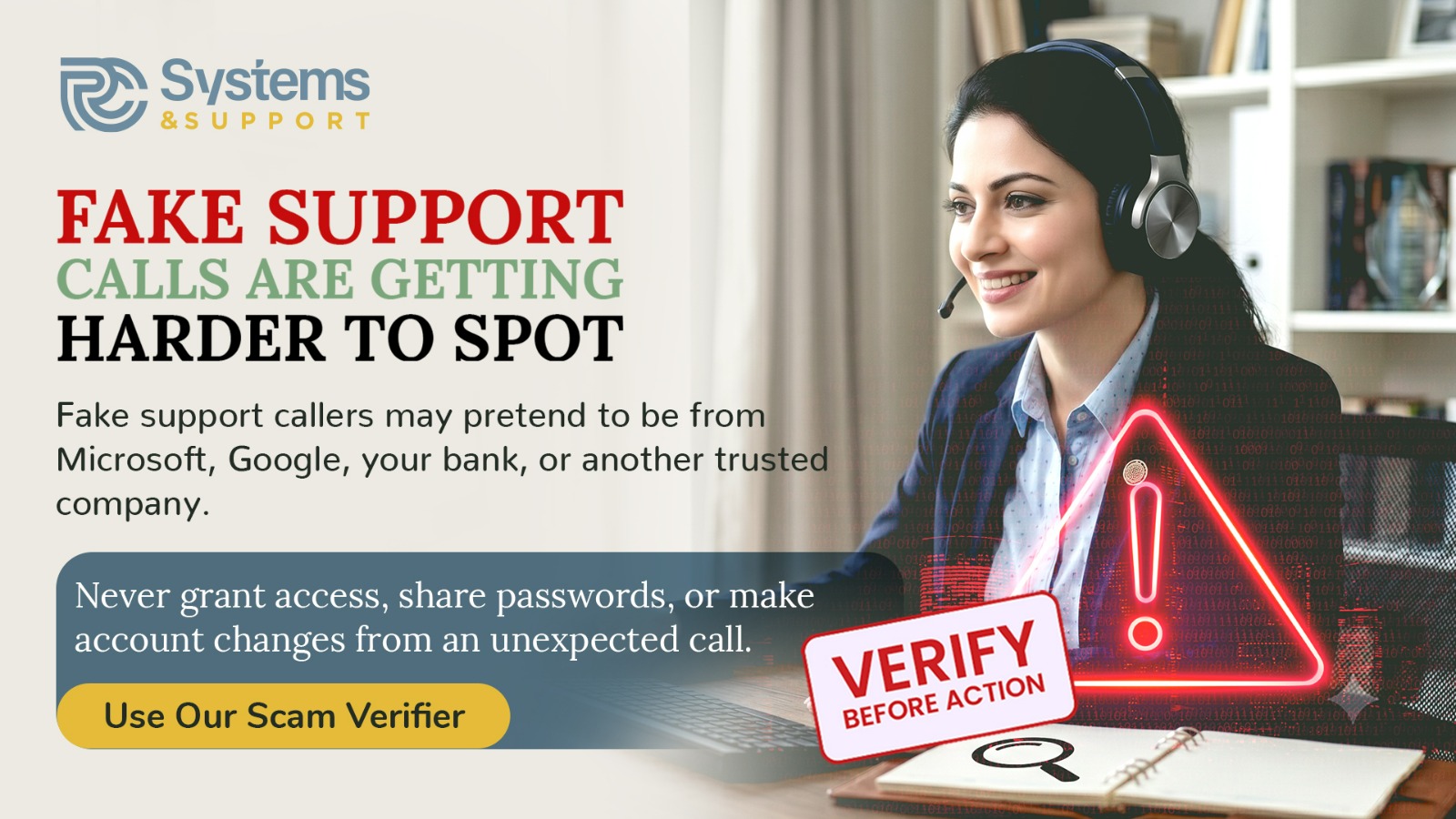
In many cases, these calls are executed with such precision, accurate terminology, confident tone, and realistic escalation paths, that they can appear more organized than the actual companies they claim to represent.
This shift represents a fundamental evolution in social engineering, where credibility is manufactured through psychological engineering rather than technical intrusion.
What was once opportunistic fraud has evolved into a structured criminal methodology.
Modern attackers no longer operate blindly. They study organizational behavior, customer support workflows, and publicly available technical documentation. Combined with AI-generated scripts and voice simulation tools, this enables them to replicate enterprise-grade communication patterns with alarming accuracy.
The result is a new class of impersonation attacks that feel operationally legitimate from the very first sentence.
Unlike traditional scams that rely on obvious pressure tactics, these interactions are carefully paced, technically fluent, and deliberately aligned with how real IT or customer support teams communicate.
These attacks typically begin with a credibility anchor, an introduction that establishes authority without raising suspicion. The caller may claim to represent a widely recognized platform such as Microsoft, Google Workspace, or a financial services provider.
The conversation is rarely aggressive at the outset. Instead, it is methodical. The attacker introduces a fabricated issue, such as unauthorized access attempts, account synchronization failures, or security policy violations, framed in language consistent with legitimate technical support procedures.
Once engagement is established, the attacker introduces procedural urgency. The victim is guided toward “verification steps” or “security remediation actions” that appear routine but are intentionally designed to compromise access.
At no point does the interaction feel disjointed or informal. This is precisely what makes modern support impersonation effective: it mirrors real operational communication structures with unsettling accuracy.
The primary risk factor is no longer technical exposure, it is procedural trust.
Most organizations are built on the assumption that employees can distinguish between legitimate and fraudulent support interactions in real time. However, modern impersonation techniques are specifically designed to exploit this assumption.
Employees are conditioned to respond quickly to perceived service disruptions. When a caller demonstrates familiarity with internal processes and uses appropriate technical vocabulary, natural skepticism is often reduced.
This creates a critical gap between security policy design and real-world behavioral execution.
Even highly trained personnel can be compromised when verification protocols are ambiguous or inconsistently enforced.
A successful impersonation call is not a minor incident. It is a potential entry point into enterprise systems.
The consequences often include unauthorized access to internal platforms, credential compromise, data exposure, and downstream lateral movement within networks. In regulated industries, the impact may extend to compliance violations and mandatory breach disclosures.
Beyond immediate technical damage, organizations also face reputational erosion. Trust, once compromised, is significantly more difficult to restore than infrastructure.
Mitigating impersonation-based attacks requires a shift from informal verification habits to structured security enforcement.
Organizations must implement verification frameworks that are independent of communication channels. In practice, this means no sensitive action should ever be executed based solely on inbound calls, regardless of perceived legitimacy.
Access control policies must also reflect operational reality. Administrative privileges should be tightly scoped, and critical actions should require multi-layer validation rather than single-point approval.
Equally important is behavioral reinforcement. Employees must be trained not only to recognize suspicious behavior but to consistently apply verification protocols under pressure. Security awareness is only effective when it translates into predictable operational behavior.
RC Systems & Support helps organizations defend against sophisticated impersonation attacks by implementing layered cybersecurity controls that integrate detection, prevention, and human behavior reinforcement.
Rather than relying on isolated security tools, we focus on building a cohesive defense architecture that aligns technical safeguards with real-world operational workflows.
Our approach includes continuous monitoring of anomalous access patterns that may indicate social engineering exploitation. This enables early identification of compromised sessions before they escalate into broader system intrusion.
We also strengthen communication security boundaries, reducing exposure to phishing-based entry points that frequently precede impersonation attempts. By limiting initial compromise vectors, organizations significantly reduce downstream risk.
In parallel, we support structured security awareness programs designed around realistic attack simulations. The objective is not theoretical knowledge, but operational readiness, ensuring employees can consistently apply verification protocols even under perceived urgency.
This combination of behavioral conditioning, system-level monitoring, and preventive architecture creates a defense model that is significantly more resilient against modern impersonation tactics.
Fake support calls are no longer isolated fraud attempts. They are part of a broader category of adversarial behavior that targets organizational trust systems rather than technical infrastructure alone.
As these attacks continue to evolve, traditional awareness training and reactive security measures are no longer sufficient.
Effective defense now requires an integrated model where human behavior, access governance, and real-time monitoring operate as a unified system.
Organizations that adopt this approach are significantly better positioned to resist both current and emerging forms of social engineering.
With structured cybersecurity support from RC Systems & Support, businesses can move beyond reactive security posture and toward operational resilience against impersonation-driven threats.
The defining challenge of modern cybersecurity is no longer stopping unauthorized access attempts, it is correctly identifying legitimate-looking deception in real time.
Fake support calls have reached a level of sophistication where tone, structure, and technical language are no longer reliable indicators of authenticity.
Organizations that succeed in this environment will be those that enforce disciplined verification culture, reduce reliance on verbal trust, and integrate security into everyday operational behavior.
In this evolving threat landscape, resilience is not achieved through awareness alone, but through consistent, system-wide enforcement of verification discipline.




.avif)
.avif)