
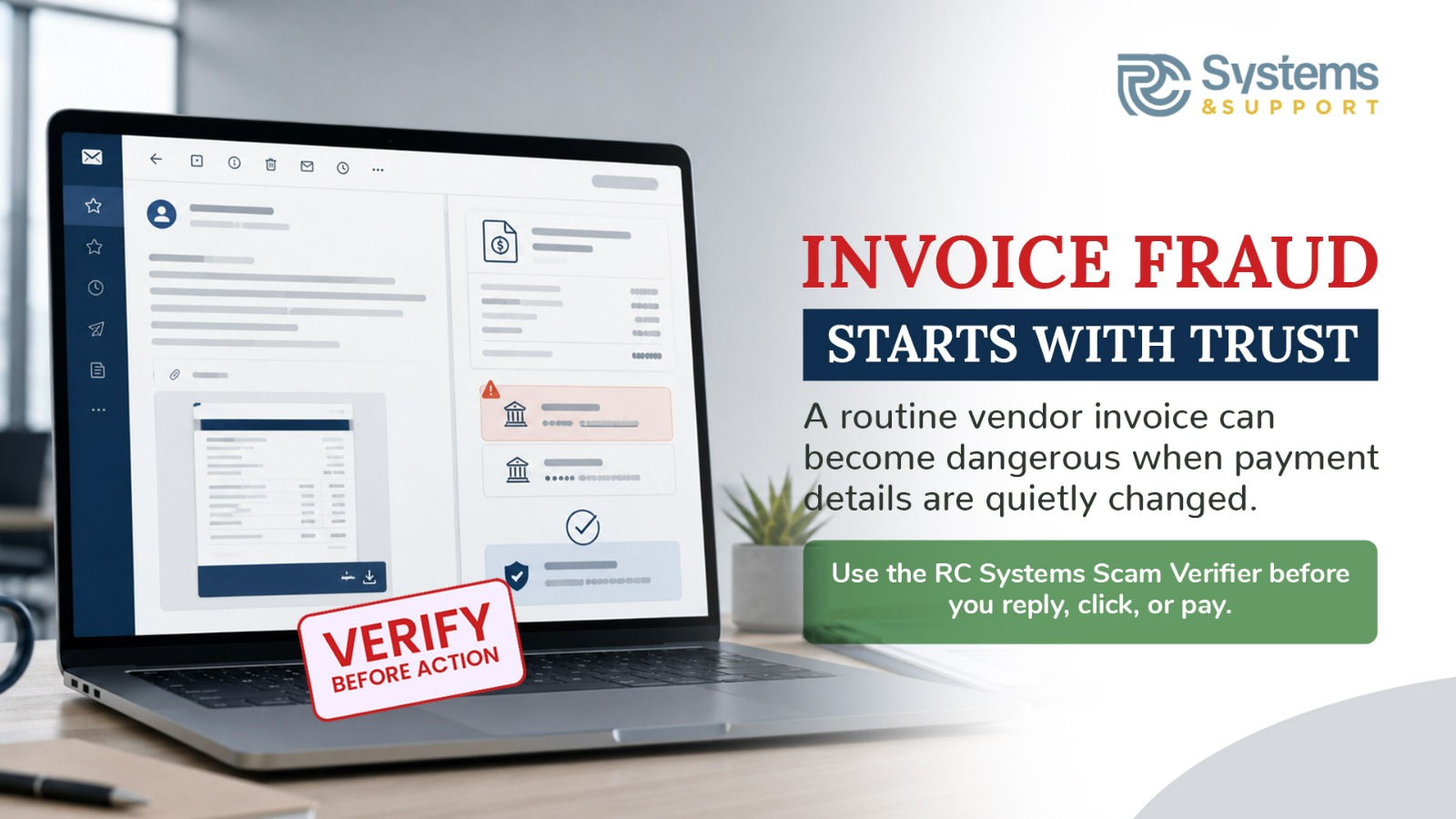
The only difference was the bank account information.
Within hours, the payment had been processed.
By the time someone noticed the discrepancy, the funds had already been transferred to a fraudulent account.
This scenario is becoming increasingly common across businesses of all sizes. Modern cyberattacks are no longer defined by dramatic system failures or obvious warning signs. More often, they begin with ordinary business interactions that exploit familiarity, trust, and routine.
Financially motivated cybercriminals have refined their tactics significantly in recent years. Rather than relying on mass phishing campaigns filled with spelling mistakes and suspicious links, many attackers now conduct targeted research before launching an attack.
They study organizational structures, monitor publicly available information, and imitate legitimate communication styles.
Invoice fraud, often associated with business email compromise (BEC), is one example of this evolution. Attackers impersonate vendors, suppliers, or executives to manipulate employees into making unauthorized payments or sharing sensitive information.
Because these requests closely resemble legitimate business communications, they can bypass even experienced professionals.
Organizations depend on efficiency. Employees process invoices, approve payments, and communicate with external partners every day.
Routine creates consistency, but it can also create assumptions.
When employees encounter familiar names and expected requests, they may rely on recognition instead of verification. Cybercriminals understand this behavior and design their attacks accordingly.
The objective is rarely technical disruption at the beginning. Instead, attackers seek to exploit trust before anyone realizes that something is wrong.
A single moment of misplaced confidence can lead to financial loss, operational disruption, and reputational damage.
In many cases, fraudulent communications contain subtle inconsistencies.
The sender's email domain may differ by a single character. Payment instructions may suddenly change without explanation. Requests that normally follow established procedures may arrive with an unusual sense of urgency.
Individually, these indicators may seem insignificant.
Collectively, they can represent the early stages of a sophisticated social engineering attack.
Organizations that encourage employees to pause, verify, and escalate concerns when something feels unusual are often better positioned to prevent incidents before they escalate.
Traditional cybersecurity training frequently focuses on technical concepts that employees may never encounter directly.
Modern awareness initiatives require a different approach.
Employees benefit most from practical guidance rooted in realistic scenarios. Understanding how invoice fraud unfolds within everyday business operations helps individuals recognize warning signs more effectively.
Security awareness should reinforce the principle that verification is a professional responsibility rather than an inconvenience.
A brief confirmation call using previously established contact information may prevent a costly mistake.
Human awareness remains essential, but it should not operate in isolation.
Advanced email security solutions can help identify suspicious communications before they reach employee inboxes. Threat detection capabilities can uncover unusual activity patterns that may indicate attempted compromise.
Continuous monitoring provides organizations with greater visibility into emerging risks, enabling faster investigation and response when concerns arise.
Layered security strategies recognize that people and technology work best together.
The goal is not to eliminate human involvement but to provide employees with systems that support better decision-making.
At RC Systems & Support, we recognize that today's cyber threats often exploit ordinary business processes rather than technical weaknesses alone.
Our approach focuses on helping organizations strengthen both their technological defenses and their operational resilience.
Through advanced threat detection and continuous monitoring, we help businesses identify suspicious activity that might otherwise go unnoticed. Our email protection solutions are designed to reduce exposure to phishing attempts and impersonation campaigns that frequently serve as entry points for broader attacks.
We also support organizations in fostering stronger security awareness practices, helping employees understand that cybersecurity is not solely the responsibility of IT departments.
Protecting a business requires a coordinated effort across people, processes, and technology.
The most effective defense against invoice fraud is not suspicion of every interaction. It is the consistent application of verification practices.
Businesses should establish clear procedures for validating payment changes, confirming unusual requests, and escalating concerns without hesitation.
These practices create operational safeguards that are difficult for attackers to overcome.
Security does not require perfection.
It requires consistency.
Organizations that prioritize verification as part of their culture are often better prepared to navigate an increasingly complex threat environment.
The invoice looked legitimate because it was designed to look legitimate.
Modern cybercriminals understand business operations, communication patterns, and human behavior. They exploit familiarity rather than force.
As these tactics continue to evolve, organizations must move beyond the assumption that obvious warning signs will always be present.
Building resilience requires a combination of awareness, verification, and proactive security measures.
With support from RC Systems & Support, businesses can strengthen their defenses against the threats hidden within everyday interactions and create a more secure foundation for future growth.




.avif)
.avif)